
Legal Exhibit Preparation: Boosting Trial Impact
- David Nguyen

- 7 days ago
- 6 min read

Presenting evidence in a packed American courtroom often means the difference between winning and losing a complex case. For litigation attorneys, the clarity and impact of exhibits can directly influence how judges and juries interpret critical facts. Mastering the art of preparing, authenticating, and organizing legal exhibits provides attorneys with a decisive edge, setting the groundwork for persuasive arguments and airtight case strategies.
Legal exhibits defined and core principles
In legal proceedings, legal exhibits are tangible pieces of evidence formally presented to support claims, substantiate testimony, or prove facts during trials. These critical components help transform abstract legal arguments into comprehensible visual narratives for judges and juries. Legal exhibits provide a concrete foundation) for understanding complex case details.
ls, or reconstructions designed to illustrate expert testimony
To be admissible, legal exhibits must meet several core principles of authentication and relevance. These include:
Maintaining an unbroken chain of custody
Proving the evidence’s direct relevance to the case
Demonstrating the exhibit’s authenticity
Ensuring the evidence has not been tampered with or altered
Exhibit management requires meticulous attention to detail. Each piece of evidence must be carefully labeled, typically using alphabetical or numerical designations like Exhibit A, Exhibit B, to create a clear tracking system. Proper labeling and documentation help attorneys and court personnel reference and understand the evidence quickly.
Pro tip: Create a comprehensive exhibit list with detailed descriptions and tracking information before trial to streamline your presentation and ensure smooth courtroom evidence management.
Types of legal exhibits in U.S. trials
In U.S. legal proceedings, attorneys rely on multiple types of exhibits to build compelling arguments and help judges and juries understand complex case details. Legal exhibits serve critical evidentiary functions by providing tangible proof and visual clarification of key case points.
Legal exhibits in American courts are typically classified into four primary categories:
Real Evidence: Tangible objects directly connected to the case
Physical weapons
Damaged equipment
Stolen items
Original documents
Documentary Evidence: Written materials substantiating claims
Contracts
Medical records
Business correspondence
Official government documents
Demonstrative Evidence: Visual aids created to explain testimony
Diagrams
Photographs
Architectural models
Forensic reconstruction charts
Illustrative Exhibits: Supplemental graphics designed to enhance understanding
Timeline displays
Comparative infographics
Statistical presentations
Expert testimony visualizations
Each exhibit type requires specific authentication protocols to ensure admissibility. Courts demand that attorneys meticulously establish the evidence’s relevance, origin, and integrity before presentation. Exhibit authentication involves demonstrating that the evidence is what the presenting party claims it to be, typically through witness testimony or expert verification.

Understanding the nuanced rules surrounding different exhibit types is crucial. While real and demonstrative exhibits often bypass traditional hearsay restrictions, documentary evidence must meet stringent legal standards. Attorneys must carefully prepare and strategically select exhibits that not only support their arguments but also comply with complex judicial evidentiary guidelines.
Here’s a comparison of legal exhibit types and their unique role in court:
Exhibit Type | Example Use Case | Distinguishing Feature |
Real Evidence | Displaying a weapon | Direct physical case connection |
Documentary Evidence | Presenting a contract | Written content as proof |
Demonstrative Evidence | Showing a diagram | Visual explanation of testimony |
Illustrative Exhibit | Using a timeline chart | Enhances clarity, not primary proof |
Pro tip: Develop a comprehensive exhibit tracking system that categorizes and cross-references each piece of evidence, ensuring seamless organization and rapid retrieval during trial proceedings.
Admissibility rules for courtroom evidence
In the complex landscape of legal proceedings, evidence admissibility rules serve as critical gatekeepers ensuring fairness and reliability in courtroom presentations. These rules create a structured framework that attorneys must navigate carefully to successfully introduce evidence during trials.
The core principles of evidence admissibility revolve around several key criteria:
Relevance: Evidence must directly relate to facts in the case
Demonstrates a material fact
Helps prove or disprove a significant legal point
Provides meaningful context to the case
Authenticity: Evidence must be proven genuine
Verifiable source
Unaltered original document
Traceable chain of custody
Reliability: Evidence must meet legal standards of credibility
Scientifically valid
Free from tampering
Professionally collected and preserved
Judicial Discretion plays a significant role in evidence admissibility. Judges can exclude evidence that fails to meet these fundamental requirements, even if technically submitted correctly. This discretionary power ensures that only substantive, trustworthy evidence influences legal proceedings.
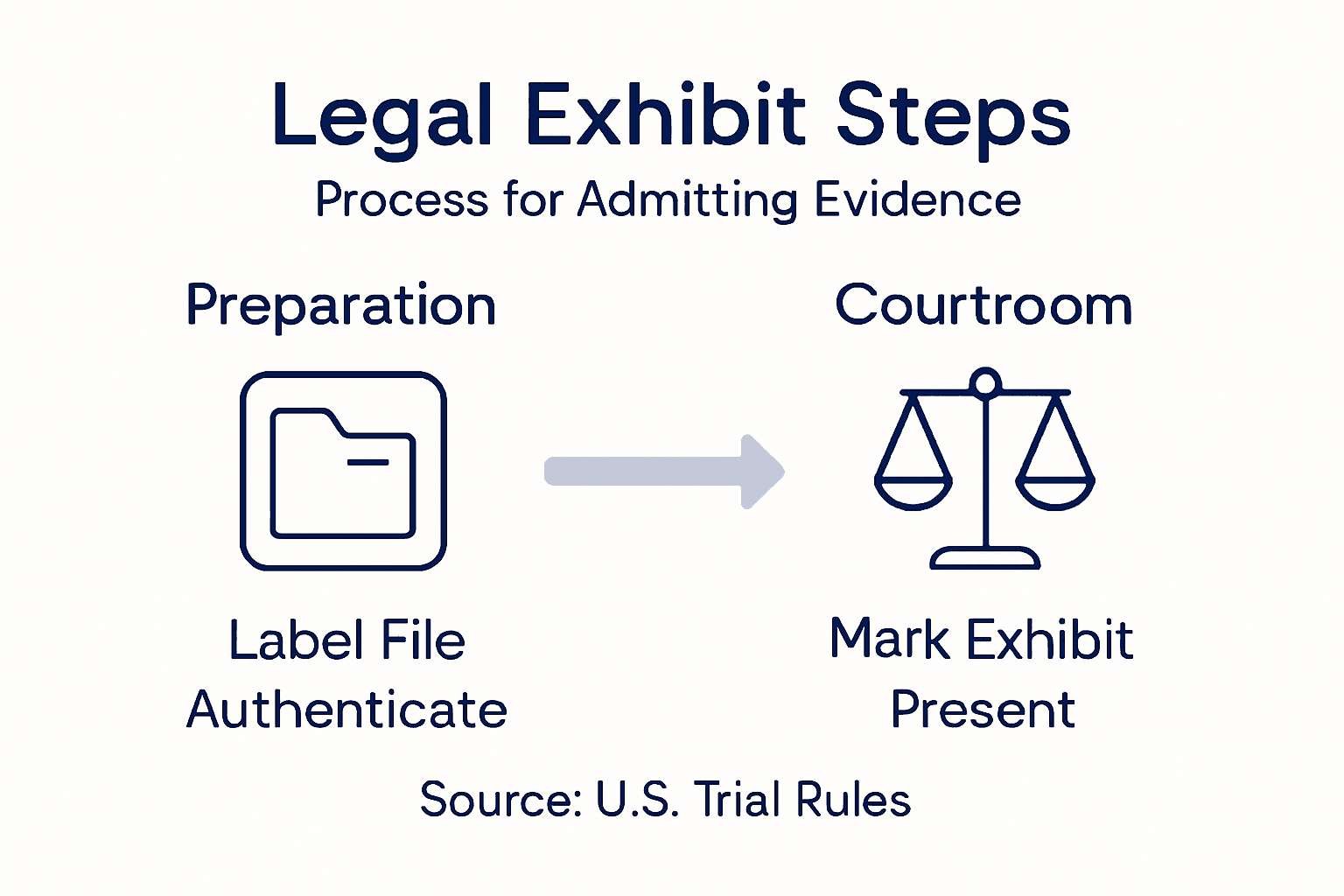
The formal process of introducing evidence involves multiple strategic steps. Attorneys must first mark the exhibit, allow opposing counsel to examine it, and then lay a comprehensive foundation proving its authenticity and relevance. Objections can be raised, and the judge will ultimately determine whether the evidence meets the necessary legal standards for admission.
Pro tip: Meticulously document the entire chain of custody for each piece of evidence, creating a detailed chronological record that demonstrates its integrity and authenticity.
Organizing and labeling exhibits effectively
Effective exhibit organization is a critical skill that can significantly impact trial success. Exhibit management strategies require meticulous attention to detail and systematic documentation to ensure smooth courtroom proceedings.
The fundamental components of a robust exhibit organization system include:
Consistent Labeling Protocols
Unique alphanumeric identifiers
Clear, legible markings
Uniform formatting across all documents
Comprehensive Exhibit Tracking
Chronological numbering
Status tracking (admitted, pending, excluded)
Cross-referencing capabilities
Digital and Physical Documentation
Printed exhibit lists
Electronic indexing systems
Backup digital copies
Exhibit Numbering Systems play a crucial role in maintaining order and accessibility. Attorneys typically use sequential lettering (Exhibit A, B, C) or numerical systems (Exhibit 1, 2, 3) depending on court preferences and case complexity. Consistency is key - once a numbering method is established, it must be maintained throughout the entire legal proceeding.
The exhibit index serves as the central nervous system of evidence management. This comprehensive document should include detailed information for each exhibit, including:
Unique identifier
Brief description
Date of origin
Current admission status
Relevance to specific case arguments
Pro tip: Create a color-coded digital and physical tracking system that allows instant verification of each exhibit’s status, admission history, and critical case relevance.
The table below summarizes effective exhibit organization techniques for courtroom efficiency:
Organization Method | Key Benefit | Typical Tools Used |
Sequential Labeling | Prevents misplacement | Alphanumeric stickers |
Chronological Tracking | Ensures clear case timeline | Numbered lists, logs |
Cross-Referencing | Speeds up evidence retrieval | Index spreadsheets, tag links |
Digital Backup Copies | Safeguards against loss | Cloud storage, USB drives |
Common mistakes and risk mitigation strategies
Legal exhibit preparation demands precision and strategic forethought. Exhibit introduction errors can potentially derail an otherwise compelling case, making risk mitigation crucial for trial success.
The most frequent mistakes attorneys encounter include:
Procedural Oversights
Inadequate exhibit marking
Failing to establish proper foundation
Neglecting opposing counsel’s right to examine evidence
Documentation Errors
Inconsistent labeling
Incomplete exhibit lists
Missing chronological tracking
Authentication Challenges
Weak chain of custody
Insufficient proof of document authenticity
Lack of expert witness verification
Proactive Risk Mitigation requires a comprehensive approach. Attorneys must develop robust strategies that anticipate potential evidentiary challenges and create systematic safeguards against potential exclusions.
Key risk management techniques involve:
Developing a standardized exhibit preparation checklist
Conducting thorough pre-trial evidence reviews
Communicating early with opposing counsel about potential admissibility
Preparing comprehensive foundation testimony
Creating detailed exhibit tracking documentation
Pro tip: Implement a digital and physical cross-referencing system that allows instant verification of each exhibit’s authentication status, ensuring seamless trial presentation.
Elevate Your Legal Exhibit Preparation with Expert Trial Technology Support
Preparing and managing legal exhibits demands precision in organization, authentication, and presentation to win your case. If you want to avoid common risks like inconsistent labeling, weak chain of custody, or courtroom delays, partnering with skilled professionals is the key. TrialTech Support LLC specializes in streamlining exhibit management, offering customized solutions that cover everything from meticulous evidence tracking to expert on-site technical assistance.
Benefits of working with our team include:
Experienced graphics specialists to craft clear demonstrative exhibits
Trusted hot seat technicians who ensure seamless courtroom presentations
Robust exhibit tracking and labeling systems to maintain exhibit integrity
Discover how our comprehensive trial technology services can transform your exhibit preparation into a smooth and impactful courtroom strategy. Don’t let procedural mistakes or technical glitches undermine your case. Visit TrialTech Support today and take the first step toward flawless trial presentation. Learn more about our tailored solutions at TrialTech Support and experience expert support designed for your case’s success.
Frequently Asked Questions
What are legal exhibits in a trial?
Legal exhibits are tangible pieces of evidence presented during trials to support claims, substantiate testimony, or prove facts. They help convey complex case details in a comprehensible manner.
What types of legal exhibits are commonly used in U.S. trials?
U.S. trials commonly use four types of legal exhibits: real evidence (tangible objects), documentary evidence (written materials), demonstrative evidence (visual aids), and illustrative exhibits (supplemental graphics).
How do I ensure my exhibits are admissible in court?
To ensure admissibility, exhibits must meet criteria such as relevance, authenticity, and reliability. Proper documentation, a clear chain of custody, and attorney preparation are essential to meeting these standards.
What are common mistakes made during legal exhibit preparation?
Common mistakes include inadequate exhibit marking, failing to establish a proper foundation, inconsistent labeling, and weak chain of custody. Avoiding these pitfalls requires thorough documentation and preparation.


Comments