
Pretrial Logistics: Enhancing Case Preparation Efficiency
- David Nguyen

- Jan 27
- 11 min read

Managing a complex litigation case in the United States often depends on more than just courtroom skill—it relies on how well your team handles the countless moving parts before trial begins. For corporate attorneys, pretrial logistics serves as the silent engine powering discovery efforts, evidence organization, and witness coordination, balancing the need for speed with accuracy and compliance. Misunderstandings about these logistics persist, yet a well-structured approach can make the difference between confident strategy and costly setbacks.
Table of Contents
Key Takeaways
Point | Details |
Importance of Pretrial Logistics | Structured pretrial logistics are essential for trial readiness and a competitive advantage, preventing disorganization that can undermine case strength. |
Myths vs. Realities | Common misconceptions about pretrial logistics can lead to inefficient practices; understanding the realities helps ensure effective case management. |
Organizational Discipline | Early and systematic planning for logistics, including risk assessment and compliance, is crucial for minimizing errors and enhancing trial outcomes. |
Technology Integration | Effective integration of technology in the war room improves productivity and supports seamless collaboration among litigation teams. |
Defining Pretrial Logistics and Common Myths
Pretrial logistics encompasses the operational infrastructure and coordination required to prepare comprehensively for trial. For corporate litigation teams, this means managing discovery materials, organizing evidence systems, coordinating witness preparation, scheduling expert consultations, and establishing the physical and technological environment where case strategy takes shape. Think of it as the backbone supporting your entire trial preparation effort—without it, even the strongest legal arguments collapse under the weight of disorganization.
The term “pretrial logistics” extends beyond simple file management. It involves orchestrating complex workflows across multiple departments, managing timelines that span months or years, coordinating with external vendors and experts, and creating systems where any team member can locate critical information within seconds. Corporate attorneys managing multimillion-dollar cases understand that a single misplaced document or missed deadline can unravel months of preparation. This is why structured pretrial logistics isn’t an afterthought—it’s a prerequisite for competitive advantage.
Misconceptions about pretrial preparation run deep in legal practice, and these myths directly impact case outcomes. One persistent myth suggests that thorough pretrial logistics adds unnecessary time and expense to case management. The reality contradicts this completely: organized systems reduce wasted hours spent searching for materials, eliminate redundant work, and allow attorneys to focus on substantive legal strategy rather than administrative chaos. Another dangerous myth assumes that basic case management software provides sufficient logistics infrastructure. Modern litigation demands integration across multiple systems, clear communication protocols, and specialized expertise in coordinating the hundreds of moving parts that converge during trial preparation.
Perhaps the most damaging myth involves believing that pretrial logistics can be managed in the final weeks before trial. Effective preparation requires systematic planning from the earliest stages of litigation. Research on pretrial justice demonstrates that proper pretrial coordination directly impacts case readiness and outcomes. Additionally, risk assessment and pretrial planning require continuous refinement throughout the case lifecycle rather than rushed implementation at the last moment. Corporate attorneys who view pretrial logistics as an ongoing operational discipline—rather than a periodic task—consistently achieve superior trial readiness and client results.
Below is a summary of key pretrial logistics myths versus the realities facing corporate litigation teams:
Common Myth | Reality | Process Impact |
Adds time and cost | Prevents wasted hours later | Increases efficiency and focus |
Basic software suffices | Requires advanced system integration | Demands cross-team coordination |
Last-minute planning works | Needs ongoing, early preparation | Reduces errors and missed deadlines |
Only file organization is needed | Involves vendor/stakeholder management | Supports strategic advantage |
Pro tip: Start pretrial logistics planning during your initial case assessment, not weeks before trial, and assign a dedicated team member to oversee coordination across all case materials and systems.
Key Categories of Pretrial Logistics Tasks
Pretrial logistics breaks down into distinct functional categories, each critical to trial readiness. Understanding these categories helps corporate litigation teams allocate resources effectively and ensure nothing falls through cracks during preparation. The primary categories include evidence management, witness coordination, expert engagement, timeline development, and physical infrastructure setup. Each category demands specific expertise and systematic workflows to function properly.
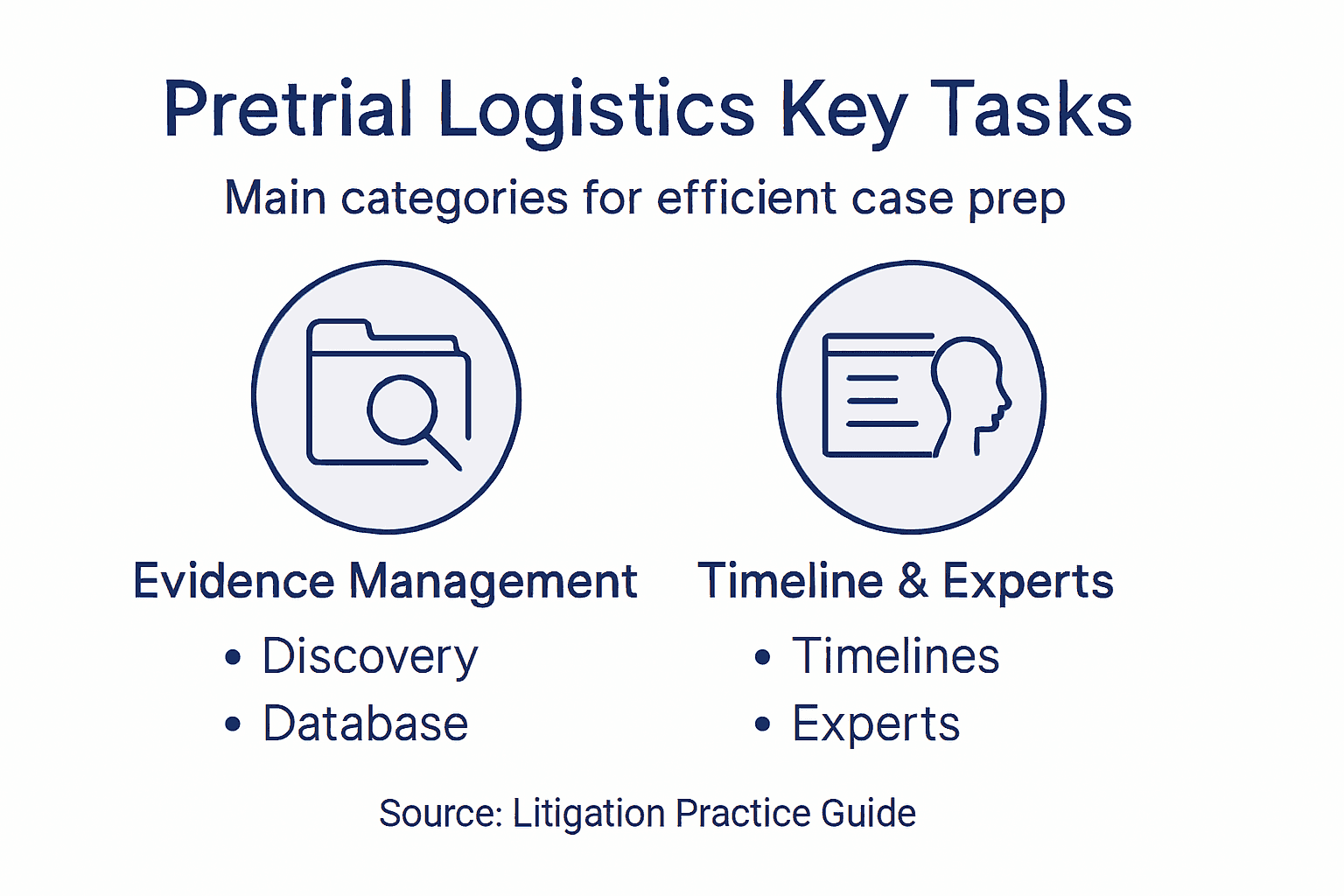
Evidence management forms the foundation of pretrial logistics. This encompasses organizing discovery materials, maintaining document control systems, categorizing exhibits by relevance and timeline, and ensuring all evidence remains admissible and traceable. For corporate cases involving thousands of documents, this task alone can consume months of coordination. Beyond simple storage, evidence management requires indexing systems that allow attorneys to cross-reference materials across multiple case theories. Witness coordination involves scheduling depositions, managing witness lists, preparing direct and cross-examination outlines, and maintaining communication channels with counsel for opposing parties. Expert engagement requires identifying qualified professionals, managing expert reports, coordinating rebuttal analyses, and ensuring expert availability for trial dates. Federal pretrial services conduct background investigations and risk assessments that inform judicial decisions, paralleling how corporate litigation teams must conduct thorough background vetting of expert witnesses and understand their credibility vulnerabilities before trial.
Timeline development establishes the skeleton upon which all other logistics hang. This includes creating case chronologies, identifying critical deadlines for discovery cutoffs, deposition schedules, and motion filing dates, and mapping out trial preparation phases. Physical infrastructure represents another essential category, encompassing the selection and setup of your trial war room, technology systems for evidence display, communication networks, and workspace for team members. Effective pretrial coordination integrates these logistics elements into a cohesive system rather than treating them as isolated functions. Stakeholder communication forms the final critical category: maintaining clear channels with clients, co-counsel, vendors, and the court ensures everyone operates from the same information and timeline.
These categories interconnect in complex ways. A delay in expert engagement impacts your timeline, which affects witness deposition scheduling, which influences evidence organization priorities. Corporate litigation teams that map these dependencies upfront avoid cascading delays that compress preparation time and increase costs exponentially. The categories also require different skill sets—some tasks demand legal expertise, others require project management discipline, and still others require specialized technical knowledge.
Here’s a quick reference for the main categories of pretrial logistics and their core responsibilities:
Logistics Category | Main Responsibility | Typical Team Expertise |
Evidence Management | Organize and track materials | Legal and technical knowledge |
Witness Coordination | Schedule and prepare witnesses | Communication and management skills |
Expert Engagement | Vet and manage experts | Subject matter and legal skills |
Timeline Development | Map deadlines and sequences | Project management experience |
Physical Infrastructure | Set up space and technology | IT and operations expertise |
Stakeholder Communication | Maintain clear updates | Coordination and client relations |
Pro tip: Create a master task matrix that maps each pretrial logistics category against your case timeline, assigning specific team members and vendors to each responsibility with clear accountability and interdependency flagging.
Critical Pretrial Documentation and Evidence Management
Documentation and evidence management form the operational core of pretrial logistics. Corporate litigation teams face a fundamental reality: any evidence not properly documented, organized, and preserved becomes difficult to use effectively at trial, regardless of its substantive value. The documentation phase begins immediately upon case intake and continues through trial conclusion. This involves creating systematic records of all materials, establishing clear chains of custody, and maintaining detailed logs of every evidence interaction. Without this discipline, you risk losing admissibility, creating credibility problems with judges and juries, and exposing yourself to sanctions or dismissal.

Digital evidence presents unique challenges that traditional document management cannot address alone. Digital evidence preservation requires rigorous documentation and chain of custody management to ensure integrity and admissibility in litigation contexts. Unlike physical documents, digital materials can be altered invisibly, copied without detection, or accidentally modified through normal computer operations. Your pretrial documentation system must account for metadata, file integrity verification, forensic imaging standards, and version control across multiple team members accessing the same materials. Physical evidence demands similarly rigorous treatment: proper photography, detailed descriptions, secure storage facilities, and restricted access logs that demonstrate the evidence remained unaltered and uncontaminated throughout pretrial preparation.
Organization systems directly impact your trial effectiveness. A well-structured evidence management system allows any attorney on your team to locate relevant materials within minutes, cross-reference exhibits across theories, and identify evidentiary gaps before deposition preparation. Corporate cases often involve thousands of documents requiring categorization by document type, custodian, date range, relevance coding, and privilege designation. Evidence-based decision making in pretrial phases depends on thorough documentation of investigative findings and risk assessments, enabling informed strategic choices throughout case development. Many litigation teams employ database systems with full-text search capabilities, allowing attorneys to query materials by keyword, concept, or custodian. This technological integration supports faster case analysis while maintaining the detailed audit trails required for admissibility challenges.
Handoff protocols between team members prevent documentation failures that occur during transitions. When one attorney reviews materials and organizes findings, the next attorney must understand exactly what work occurred and what conclusions were reached. Clear documentation of analytical work, expert consultations, and strategic decisions creates institutional knowledge that survives personnel changes and supports continuity through trial.
Pro tip: Implement a single master evidence database with standardized naming conventions, consistent metadata tagging, and automated backup procedures rather than allowing attorneys to maintain separate spreadsheets or document folders, which inevitably create duplication and gaps.
Technology Integration and War Room Setup
Your trial war room functions as mission control for case preparation. It serves as the physical and digital nerve center where attorneys, paralegals, consultants, and vendors converge to analyze evidence, develop strategy, and prepare for courtroom presentation. The effectiveness of this space depends almost entirely on how well you integrate technology systems with physical layout and workflow design. A poorly equipped war room forces your team to work around technological limitations, wasting hours on data retrieval and creating communication bottlenecks that compress preparation time. A well-designed space with integrated technology multiplies your team’s productivity and reduces costly mistakes.
War room command centers enhance information flow and decision-making through advanced technologies for real-time data visualization and collaborative communication. For corporate litigation teams, this means integrating multiple systems into a cohesive workspace: evidence databases that attorneys can access instantly, large display screens for witness deposition video review and exhibit analysis, video conferencing systems for coordinating with remote experts and co-counsel, and secure networks that maintain privileged communication protections. The physical layout must support different work modes. Some team members need focused individual workspace for document review and analysis. Others need collaborative spaces with large tables for strategy sessions and exhibit organization. Still others require dedicated areas for client meetings or expert witness preparation, separate from the main working area to maintain confidentiality.
Technology adoption in pretrial environments requires deliberate planning around user experience and organizational workflow. Successful technology implementation depends on ease of integration and organizational culture, not merely acquiring advanced equipment. Your team members will resist systems that feel complicated or require extensive training to operate. Unified data interfaces allow everyone to access materials through familiar search and retrieval methods. Real-time visualization tools transform raw evidence into comprehensible strategic presentations. Mobile connectivity allows attorneys to access case materials from deposition locations or client offices, breaking the constraint that all work must happen physically in the war room. The war room setup must account for security protocols that prevent accidental disclosure of privileged materials while maintaining accessibility for authorized team members.
Budget allocation for war room technology demands strategic thinking. Expensive equipment purchased without corresponding workflow integration wastes resources and frustrates users. Conversely, inadequate technology forces expensive attorney time into manual tasks that systems could automate. The most cost-effective approach involves identifying your specific case demands, selecting technology that directly addresses those demands, and ensuring your team receives training that builds confidence and adoption.
Pro tip: Before selecting war room technology, map your team’s actual workflows over a practice case, identifying pain points where technology could save time, then select integrated solutions rather than point tools that require manual data transfer between systems.
Responsibilities and Common Pitfalls for Counsel
Counsel managing pretrial logistics bears responsibilities that extend far beyond organizing documents and scheduling depositions. Your professional obligations encompass ensuring compliance with discovery rules, maintaining ethical standards, protecting privileged communications, and coordinating with opposing counsel in ways that uphold the integrity of the legal process. These responsibilities create tension with the practical pressures of case management. You face demands to move quickly, reduce costs, and prepare comprehensively, yet you cannot compromise ethical standards or cut corners on procedural compliance regardless of business pressure. Understanding this tension clarifies why pretrial logistics failures often stem from ethical lapses rather than mere disorganization.
Conflicts of interest represent a primary ethical vulnerability in pretrial practice. As case teams expand to include paralegals, consultants, vendors, and external experts, the risk multiplies that someone on your team has an undisclosed relationship with opposing counsel, a party, or a witness. Beyond obvious conflicts, subtle issues emerge when team members have financial interests in case outcomes, when vendors have access to sensitive strategy information, or when expert witnesses receive contingent compensation arrangements. Counsel must maintain honesty and fairness while avoiding conflicts of interest in all professional dealings, a duty that demands proactive screening and continuous vigilance. Many corporate litigation teams assume that initial conflict checks suffice, then fail to update those checks as new vendors or consultants join the case. This creates exposure to disciplinary action and potential malpractice claims.
Confidentiality breaches occur more often through carelessness than malice. War rooms contain extraordinarily sensitive materials: client communications, attorney work product, strategy memoranda, and evidence that has not yet been disclosed. Access control failures happen when team members forward emails to the wrong recipient, when consultants inadvertently mention case details in social settings, or when physical evidence sits visible in spaces where opposing counsel or media representatives might observe it. Ethical counsel vigilance against boundary issues and confidentiality failures protects clients throughout pretrial processes, requiring clear protocols and enforcement mechanisms. The most dangerous pitfall involves assuming that verbal instructions suffice. Written guidelines for document handling, communication protocols, and vendor access prevent misunderstandings that create ethical violations.
Discovery compliance represents another critical responsibility where counsel frequently stumble. Inadvertent production of privileged materials, failure to preserve electronically stored information, missing documents that should have been disclosed, or producing documents without proper review creates problems that compound exponentially as trial approaches. These failures expose you to sanctions, adverse inferences about missing evidence, and arguments that your client lacks credibility. The solution requires systematic procedures: defined responsibility for preservation notices, documented review protocols before production, and quality control checks that verify completeness. Corporate counsel managing complex litigation must treat discovery compliance as a core responsibility requiring dedicated personnel and accountability metrics, not something delegated casually to paralegal staff without oversight.
Pro tip: Establish a written compliance checklist covering privilege review, discovery preservation, conflict screening, and confidentiality protocols, then assign specific individuals accountability for each item with monthly verification signatures, creating an audit trail that demonstrates diligent ethical practice.
Elevate Your Pretrial Logistics with Expert Trial Technology Support
Pretrial logistics involves complex coordination across evidence management, expert engagement, timeline development, and war room setup. The article highlights critical challenges such as avoiding last-minute preparation, maintaining ethical compliance, and integrating advanced technologies to streamline workflow. Managing these demands requires more than basic software or fragmented solutions. It calls for expert support that ensures seamless technology integration and meticulous coordination to prevent costly delays or errors on trial day.

Partner with TrialTech Support to transform your pretrial logistics from a source of stress into a competitive advantage. Our team specializes in building fully equipped war rooms, providing skilled graphics and hot seat technicians, and delivering reliable onsite IT+ support tailored to your case needs. Don’t wait until the final weeks before trial to address these critical tasks. Start early, stay organized, and empower your litigation team with proven technology solutions designed for efficiency and compliance. Visit TrialTech Support now to learn how we can help you maintain control and maximize case readiness.
Frequently Asked Questions
What are pretrial logistics?
Pretrial logistics refer to the operational infrastructure and coordination necessary for comprehensive trial preparation, including managing discovery materials, organizing evidence systems, and coordinating witness preparation.
Why is effective pretrial preparation important?
Effective pretrial preparation is vital because it prevents wasted time and resources, enhances efficiency, and ensures that crucial information is organized and accessible, thus improving the likelihood of a favorable case outcome.
What common myths exist about pretrial logistics?
Common myths include the belief that pretrial logistics add unnecessary time and costs, that basic case management software is sufficient, and that pretrial planning can be left to the last minute, all of which can negatively impact case readiness.
What are the key responsibilities of counsel in managing pretrial logistics?
Counsel is responsible for ensuring compliance with discovery rules, maintaining ethical standards, protecting privileged communications, coordinating with opposing counsel, and overseeing the organization of documentation and evidence management.
Recommended

Comments