
Trial Presentation Terminology: Clarity for Court Success
- TrialTech Support LLC

- Feb 5
- 6 min read

What makes a trial presentation stand out in a crowded courtroom? Mastering the language behind legal evidence and evolving technology often separates persuasive arguments from overlooked details. For trial attorneys handling complex cases, understanding precise terminology is the key to clear communication and strategic courtroom impact. This guide highlights essential concepts in legal vocabulary and technology integration, ensuring you can build compelling narratives that resonate with juries and judges.
Defining Trial Presentation Terminology in Court
Navigating the complex landscape of legal proceedings requires mastering specific trial presentation terminology. Attorneys and legal professionals must understand precise language that communicates evidence, strategy, and legal arguments effectively in court. Legal terminology definitions form the critical foundation for clear communication during trials.
Understanding key trial presentation terminology involves recognizing several fundamental categories:
Evidentiary Terms
Exhibits: Physical or digital materials presented as evidence
Affidavits: Written statements made under oath
Depositions: Sworn testimonial records taken outside courtroom
Procedural Terms
Objections: Formal challenges to presented evidence or statements
Redirect: Follow-up questioning after cross-examination
Motion: Formal request made to the court
Communicating these terms precisely allows legal teams to articulate complex arguments with clarity and strategic intent. Professional trial presentations rely on exact language to build compelling narratives that resonate with judges and juries.
Technical communication in courtrooms demands nuanced understanding of specialized vocabulary. Legal terms from official sources provide attorneys comprehensive references for maintaining professional communication standards during trial proceedings.
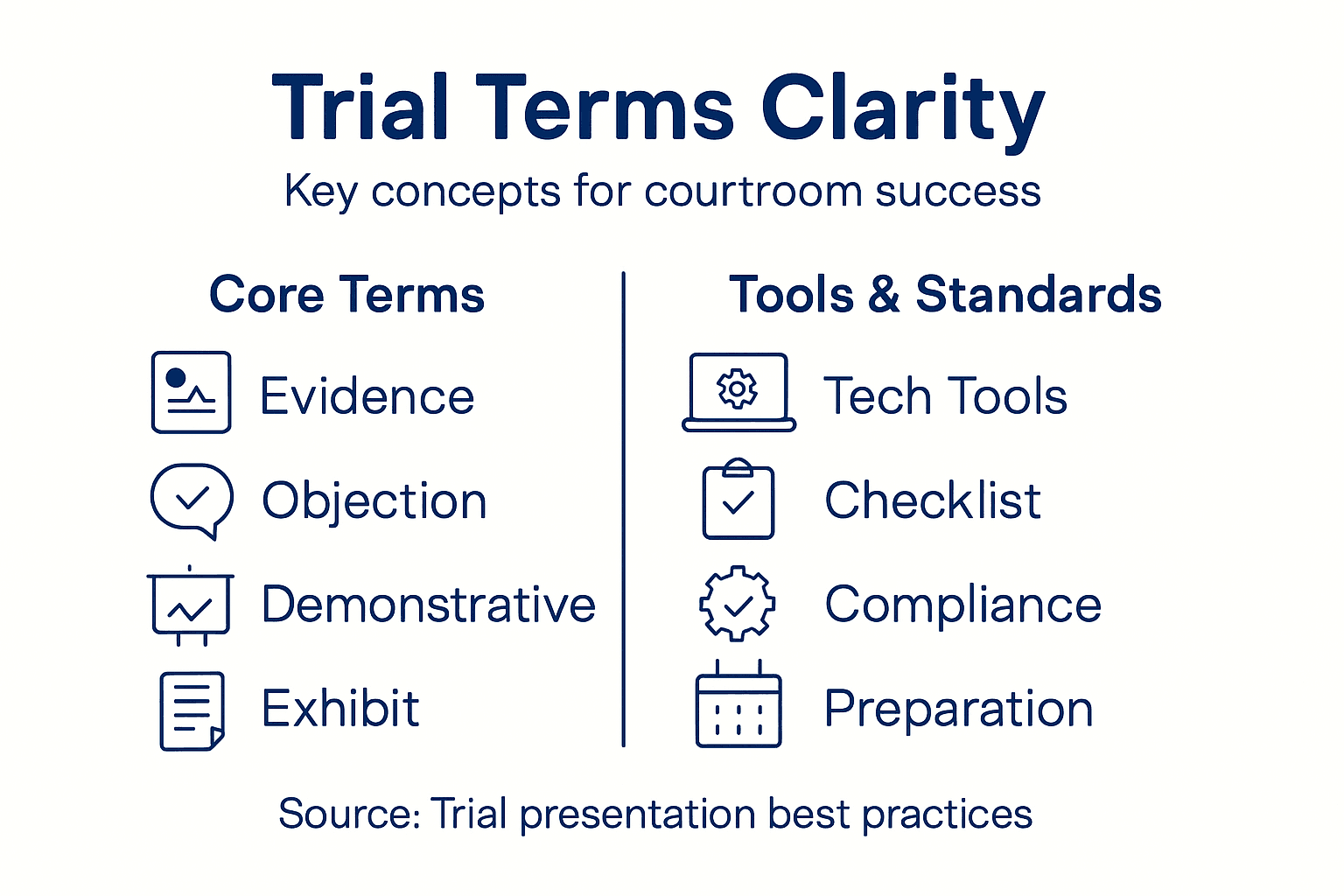
Pro tip: Master 10-15 core trial presentation terms to significantly improve your courtroom communication effectiveness.
Types of Exhibits and Presentation Tools
In the intricate world of legal proceedings, attorneys rely on various exhibit types and presentation technologies to effectively communicate case details. Exhibit categories and presentation strategies play a crucial role in helping judges and juries understand complex legal arguments and evidence.
Exhibits can be classified into several primary categories:
Documentary Exhibits
Contracts
Written agreements
Official records
Email communications
Physical Exhibits
Tangible objects
Photographs
Medical records
Material evidence
Demonstrative Exhibits
Visual aids
Charts
Graphs
Animations explaining complex concepts
Modern trial presentation technologies have revolutionized how legal professionals manage and display evidence. Advanced courtroom presentation tools now enable seamless digital integration, allowing attorneys to manipulate and present exhibits with unprecedented precision and clarity.

Technological advancements have transformed traditional courtroom presentations. Cloud-based applications and specialized software platforms provide attorneys with robust tools for organizing, annotating, and presenting exhibits dynamically. These technologies help legal teams create compelling visual narratives that can significantly impact case outcomes.
Pro tip: Develop a comprehensive digital exhibit management strategy that allows quick retrieval and smooth presentation of key evidence during trials.
Legal Standards for Trial Presentations
Trial presentations must adhere to rigorous legal standards that ensure fairness, transparency, and ethical conduct throughout judicial proceedings. International legal principles for trial conduct provide a comprehensive framework for maintaining the integrity of legal arguments and presentation strategies.
Key legal standards for trial presentations encompass several critical dimensions:
Ethical Considerations
Truthfulness
Avoiding misleading statements
Respecting court procedures
Maintaining professional integrity
Procedural Requirements
Adhering to rules of evidence
Protecting witness confidentiality
Ensuring fair representation
Maintaining courtroom decorum
Communication Standards
Clear and concise argumentation
Objective presentation of facts
Avoiding inflammatory language
Respecting judicial guidelines
Legal frameworks for effective trial communication emphasize the importance of tailoring presentations to specific audience needs. Attorneys must balance compelling storytelling with strict adherence to legal standards, creating narratives that are both persuasive and procedurally sound.
Successful trial presentations require a nuanced understanding of legal standards that go beyond mere factual presentation. Attorneys must navigate complex ethical guidelines, ensuring that every visual aid, verbal argument, and exhibit meets the highest standards of legal and professional conduct.
Pro tip: Develop a pre-presentation checklist that verifies compliance with all relevant legal and ethical standards for courtroom communication.
Technology’s Role in Modern Presentations
Digital technologies have fundamentally transformed trial presentations, creating unprecedented opportunities for attorneys to communicate complex information more effectively. Digital transformations in court technology are revolutionizing how legal professionals prepare, present, and manage case materials.
Key technological innovations in trial presentations include:
Case Management Technologies
Electronic document repositories
Real-time evidence sharing platforms
Cloud-based collaboration tools
Secure digital evidence management systems
Presentation Enhancement Tools
Interactive visual exhibits
High-resolution display systems
Animated graphical reconstructions
Multi-media evidence integration
Communication Technologies
Remote hearing capabilities
Live video testimony platforms
Synchronized exhibit display systems
Digital annotation tools
Demonstrative exhibit technologies enable attorneys to create compelling visual narratives that simplify complex testimony. Advanced presentation technologies allow legal teams to transform abstract concepts into clear, engaging visual stories that help judges and juries better understand intricate legal arguments.
Modern trial technologies are not just supplementary tools but essential components of effective legal communication. These digital solutions provide attorneys with unprecedented capabilities to organize, present, and contextualize evidence with remarkable precision and clarity.
Here’s a quick reference comparing key trial presentation technologies and their typical courtroom benefits:
Technology Type | Main Feature | Courtroom Benefit |
Document Management System | Organizes digital evidence | Faster evidence retrieval |
Interactive Visual Exhibit | Touchscreen annotation tools | Enhances juror understanding |
Video Testimony Platform | Supports live remote witness | Enables remote appearances |
High-Resolution Display | Large clear screens for evidence | Improves viewing for all participants |
Cloud Collaboration Tool | Real-time team document sharing | Streamlines legal team coordination |
Pro tip: Invest time in mastering digital presentation technologies before trial to ensure seamless, professional technical performance.
Common Pitfalls and How to Avoid Them
Trial presentations demand precision and strategic communication, yet attorneys frequently encounter predictable challenges that can undermine their effectiveness. Common presentation effectiveness strategies reveal critical areas where legal professionals must remain vigilant to maintain courtroom credibility.
Most frequent trial presentation pitfalls include:
Content-Related Challenges
Information overload
Unclear narrative structure
Lack of compelling storytelling
Inconsistent messaging
Technical Execution Problems
Poor visual design
Ineffective exhibit transitions
Unrehearsed technology usage
Complex or cluttered slides
Delivery Weaknesses
Monotonous speaking style
Insufficient audience engagement
Lack of emotional resonance
Uncertain or hesitant presentation
Effective slide design principles recommend focusing each visual element on a single, clear concept. Attorneys must transform complex legal arguments into digestible, visually compelling narratives that maintain judicial and jury attention while preserving factual integrity.
Successful trial presentations require meticulous preparation, strategic design, and confident delivery. Legal professionals must anticipate potential communication barriers and develop robust strategies to overcome them, ensuring their arguments remain clear, persuasive, and legally sound.
The table below summarizes common trial presentation pitfalls alongside recommended strategies to avoid them:
Common Pitfall | Why It Occurs | How To Avoid |
Information Overload | Including too many details | Prioritize and simplify core evidence |
Unrehearsed Technology Use | Lack of tech preparation | Practice with equipment before trial |
Monotonous Delivery | Reading slides verbatim | Engage audience through variation |
Poor Visual Slide Design | Cluttered or unclear visuals | Use one concept per slide |
Lack of Narrative Structure | Jumping between topics | Follow a logical, story-driven flow |
Pro tip: Create a comprehensive pre-presentation checklist that systematically addresses potential technical, content, and delivery challenges.
Elevate Your Trial Presentations with Expert Support
Mastering trial presentation terminology is essential for courtroom clarity and success. The article highlights challenges like managing complex exhibits, adhering to strict legal standards, and avoiding technical pitfalls that can distract or confuse your audience. Your goal is clear communication supported by seamless technology and professional execution—exactly where tailored trial technology services become indispensable.
At TrialTech Support, we understand the critical need to handle every aspect of your trial presentation with precision. Our skilled graphics specialists and seasoned “hot seat” operators ensure that your exhibits and digital evidence are presented flawlessly. Whether you require pretrial logistics management or dynamic onsite IT+ support to keep your technology running smoothly, our team is ready to help. Explore how our customized services bridge the gap between complex legal terminology and persuasive courtroom storytelling by visiting TrialTech Support.
Ready to transform your courtroom communication and avoid common trial presentation pitfalls? Connect with our experts now to craft a powerful and compliant presentation strategy that leaves a lasting impact. Visit TrialTech Support to get started today.
Frequently Asked Questions
What are the main categories of trial presentation terminology?
Key trial presentation terminology can be grouped into evidentiary terms, procedural terms, and communication standards. Understanding these categories helps attorneys effectively articulate arguments in court.
What types of exhibits are commonly used in trial presentations?
Exhibits in trial presentations can be categorized into documentary exhibits (like contracts and emails), physical exhibits (such as tangible objects and photographs), and demonstrative exhibits (including visual aids and charts).
How does technology enhance trial presentations?
Technology enhances trial presentations through tools like electronic document management systems, interactive visual exhibits, and remote testimony platforms, which facilitate clear and dynamic communication of complex information.
What are common pitfalls to avoid during trial presentations?
Common pitfalls include information overload, unstructured narratives, poor visual design, and monotonous delivery. Preparing thoroughly and using clear visuals can help avoid these challenges.

Comments