
Why Invest in Trial Prep: Courtroom Success and Efficiency
- TrialTech Support LLC
- 23 hours ago
- 6 min read

Every seasoned litigator knows that meticulous trial preparation is the bedrock of courtroom success. In major American cities, where complex cases and tight deadlines collide, efficient planning and strategic organization set top-performing lawyers apart. By mastering comprehensive case analysis and leveraging targeted support from pretrial services and expert consultants, you gain a decisive edge in both presentations and trial logistics. Effective trial prep transforms challenging legal matters into controlled, persuasive narratives that resonate with judges and juries.
Defining Trial Prep and Its Essentials
Trial preparation represents a critical strategic process where legal professionals systematically organize and plan their courtroom approach to maximize potential success. At its core, trial prep involves comprehensive case analysis, evidence management, and strategic development of persuasive legal arguments. Litigation teams invest significant time and resources into this crucial phase to ensure they present the most compelling narrative possible.
The essential components of effective trial preparation include:
Comprehensive case fact analysis
Strategic evidence evaluation
Witness preparation and testimony refinement
Developing compelling legal arguments
Creating visual presentation materials
Anticipating potential counterarguments
Pretrial services programs play a fundamental role in this process, conducting detailed investigations that help judges make informed decisions about case management. These investigations include sophisticated risk assessments, defendant monitoring, and support mechanisms that enhance overall courtroom efficiency.
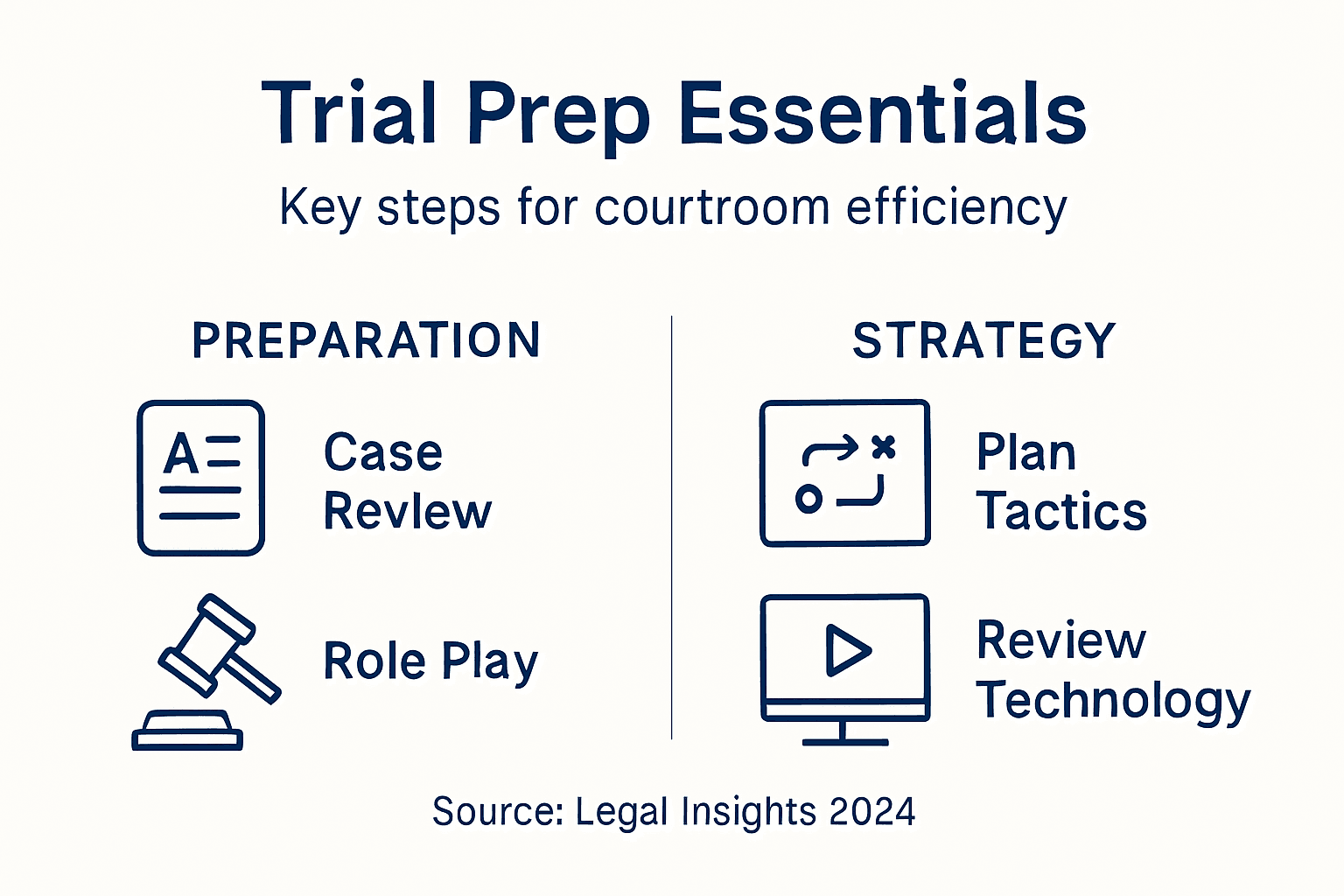
Professional trial preparation goes beyond simple document review. It requires a strategic approach that involves role-playing trial scenarios, conducting mock trials, and developing nuanced communication strategies. Legal professionals must anticipate potential challenges, prepare responsive strategies, and create a comprehensive presentation that resonates with judges and juries.
Pro tip: Invest at least 20-30 hours in comprehensive trial preparation for every hour you expect to spend in actual courtroom proceedings.
Types of Trial Preparation Services
Trial preparation services encompass a diverse range of specialized support designed to enhance legal strategies and courtroom performance. These professional services leverage expert knowledge and advanced techniques to help attorneys develop comprehensive case presentations that maximize their chances of success.
Pretrial services programs offer critical support across different legal jurisdictions, providing essential functions such as:
Comprehensive risk assessment
Defendant background investigations
Supervision and monitoring recommendations
Court release condition evaluations
Case management support
Defendant tracking and reporting
Professional trial consultants bring specialized skills from multiple academic disciplines to optimize legal strategies. These experts focus on critical areas including:
Jury selection strategies
Witness preparation techniques
Mock trial facilitation
Argument development and refinement
Psychological profiling of potential jurors
Communication strategy optimization
The most sophisticated trial preparation services integrate advanced technological tools with deep legal expertise. Trial consultants employ complex analytical methods to help attorneys anticipate potential jury reactions, develop nuanced communication approaches, and create compelling narrative strategies that resonate with judicial decision-makers.
Pro tip: Select trial preparation services that demonstrate expertise across multiple domains and can provide comprehensive, integrated support for your specific legal challenge.
Compare the main types of professional trial preparation services and their focus areas:
Service Type | Expertise Highlight | Benefit to Legal Teams |
Pretrial Services | Jurisdictional case management | Ensures efficient court procedures and monitoring |
Trial Consultants | Jury analysis and communication | Maximizes persuasive argument and jury selection |
Tech-Integrated Solutions | Data analytics and modeling | Anticipates reactions and streamlines strategy |
Role of Technology and Skilled Specialists
In the complex landscape of trial preparation, the synergy between skilled specialists and advanced technological tools has become increasingly critical for delivering sophisticated legal strategies. Legal technology transforms traditional approaches by providing powerful platforms that enhance communication, data management, and strategic planning.
Skilled trial specialists play pivotal roles in trial preparation, bringing specialized expertise across multiple domains:
Principal investigators
Research coordinators
Data management experts
Compliance specialists
Technical documentation professionals
Strategic communication analysts
Technology provides essential support through multiple innovative platforms:
Centralized data management systems
Electronic documentation tools
Advanced workflow automation software
Real-time collaboration platforms
Secure communication networks
Comprehensive case tracking technologies
Clinical trial team structures demonstrate how integrated technology and human expertise can dramatically improve preparation efficiency. Modern trial preparation requires a holistic approach that combines professional skills with cutting-edge technological solutions, enabling legal teams to navigate complex procedural landscapes with unprecedented precision and strategic depth.

Here’s a quick summary of how key trial preparation roles and technologies interact to optimize case outcomes:
Specialist Role | Key Technology Used | Impact on Trial Prep |
Research Coordinator | Electronic documentation tools | Ensures data accuracy and traceability |
Data Management Expert | Centralized data systems | Enhances evidence analysis and organization |
Compliance Specialist | Workflow automation software | Streamlines adherence to regulatory protocols |
Strategic Communication Analyst | Secure communication platforms | Improves team collaboration and case presentation |
Pro tip: Invest in continuous technology training for your specialists to ensure seamless integration of human expertise and technological capabilities.
Legal Standards and Compliance Requirements
Legal preparation demands meticulous adherence to complex regulatory frameworks that govern trial processes and protect participant rights. Compliance standards represent a critical foundation for maintaining legal integrity and ensuring ethical conduct throughout the trial preparation and execution stages.
Clinical trial regulations in the United States encompass multiple critical domains:
FDA regulatory requirements
Food, Drug, and Cosmetic Act provisions
Common Rule for human subjects research
Informed consent protocols
Safety reporting guidelines
Participant protection standards
Key legal compliance requirements include:
Comprehensive documentation maintenance
Rigorous participant screening processes
Transparent adverse event reporting
Ethical research conduct standards
Data integrity preservation
Comprehensive risk management protocols
Good Clinical Practice guidelines provide a comprehensive framework that ensures legal and ethical standards are consistently applied across trial preparation and execution. These guidelines mandate thorough monitoring, precise documentation, and unwavering commitment to participant safety and research integrity.
Pro tip: Develop a comprehensive compliance checklist that maps regulatory requirements to each stage of your trial preparation process to minimize potential legal risks.
Financial and Strategic Benefits for Lawyers
Investing in comprehensive trial preparation offers law firms strategic advantages that extend far beyond immediate case outcomes. Legal preparedness transforms litigation from a potentially risky endeavor into a calculated strategic opportunity with measurable financial and professional benefits.
Financial analysis skills enable lawyers to optimize case strategies through several critical approaches:
Precise case valuation techniques
Advanced risk assessment methodologies
Strategic settlement negotiation frameworks
Cost-benefit litigation analysis
Comprehensive financial evidence interpretation
Proactive risk mitigation strategies
Strategic trial preparation delivers multifaceted professional advantages:
Enhanced client trust and reputation
Improved case success probabilities
Increased potential for favorable settlements
Reduced overall litigation expenses
More efficient resource allocation
Stronger long-term client relationships
Strategic litigation preparation transforms legal practice by positioning lawyers as sophisticated problem solvers who can deliver nuanced, financially intelligent solutions. This approach not only improves immediate case outcomes but also builds a foundation for sustained professional growth and client confidence.
Pro tip: Treat each trial preparation investment as a strategic opportunity to build your professional brand and long-term practice value.
Common Mistakes and Risk Reduction Strategies
Navigating the complex landscape of trial preparation requires a proactive approach to identifying and mitigating potential risks. Legal risk management is not about eliminating all uncertainties, but strategically minimizing vulnerabilities that could compromise case effectiveness.
Trial preparation mistakes frequently stem from fundamental operational oversights:
Inadequate court rule comprehension
Poor scheduling and deadline management
Lack of coordinated team communication
Insufficient evidence organization
Incomplete witness preparation
Neglecting procedural documentation requirements
Effective risk reduction strategies involve comprehensive preparation techniques:
Develop detailed trial management plans
Establish clear team communication protocols
Conduct thorough pre-trial rule reviews
Create systematic evidence tracking systems
Implement rigorous witness preparation programs
Build redundant documentation processes
Trial management optimization requires a multifaceted approach that integrates technological tools, standardized workflows, and strategic planning. By systematically addressing potential vulnerabilities, legal teams can transform risk management from a reactive task into a proactive competitive advantage.
Pro tip: Create a comprehensive risk assessment checklist that you review and update for each case, treating potential vulnerabilities as opportunities for strategic improvement.
Elevate Your Trial Preparation with Expert Technology Support
The article highlights the critical need for thorough trial preparation to enhance courtroom success and efficiency. Key challenges include managing complex evidence, coordinating skilled specialists, and ensuring flawless communication throughout your case. If you are looking to overcome these pain points and implement strategic trial management with precision, expert technical support is essential. Terms like “trial consultants,” “evidence tracking,” and “seamless operations” emphasize the importance of a reliable partner who can handle every detail from graphics to logistics.
Boost your trial readiness by partnering with TrialTech Support LLC. We specialize in providing comprehensive trial technology services, including skilled graphics specialists, experienced hot seat technicians, and onsite IT support designed to keep your team focused and efficient. Do not let avoidable technical risks or logistical challenges undermine your preparation. Discover how you can achieve courtroom confidence through expert service. Visit our main site now to learn more and secure the support your legal team deserves.
Frequently Asked Questions
What is trial preparation?
Trial preparation is a strategic process where legal professionals organize and plan their courtroom approach, including case analysis, evidence management, and the development of persuasive legal arguments.
Why is investing time in trial preparation important?
Investing time in trial preparation enhances case success probabilities, builds client trust, and improves overall efficiency in resource allocation, leading to better outcomes in the courtroom.
How many hours should I invest in trial preparation for courtroom success?
It’s recommended to invest at least 20-30 hours in comprehensive trial preparation for every hour you expect to spend in actual courtroom proceedings to maximize effectiveness.
What are common mistakes to avoid during trial preparation?
Common mistakes include inadequate understanding of court rules, poor scheduling, lack of team communication, insufficient evidence organization, and incomplete witness preparation.